Sunday, July 29, 2012

Citius, Altius, Fortius.

After 8 years of preparation, the curtains went up on the Olympics on Friday, 27th July in London. The Olympics is the world's most awaited event, especially by athletes who take special pride in winning an Olympic medal.


The Olympic motto is "Citius, Altius, Fortius." These three Latin words mean "Swifter, Higher, Stronger."

The London Olympics had a tough act to follow. The Chinese has managed to create an event that was spectacular at Beijing in 2008. And the world was watching. What would the British do to make their Olympics remarkable and memorable.


In my opinion they succeeded. Their strategy was Simple. And I think that's what helped them succeed. The first brilliant move was to get a filmmaker to direct the show. And they chose Danny Boyle, Oscar winner for his film "Slumdog Millionaire". And then it was left to Boyle, who once again did something extremely clever.

In his words, "You can't get bigger than Beijing. So that, in a way, kind of liberated us. We thought: "Great. OK. Good. We'll do something different then." Its not unspectacular and unambitious - quite the reverse. This is our land, really. These are our islands. And this will be the last time we get something like this. There has to be a modesty. You can't get grandiose with this job because you are following Beijing. It is a late call for our nation, I think because we are learning our new place in the world. I don't think its eccentric but then I wouldn't because I'm British. But others might think it is."


And that is exactly what he delivered. A story. A musical. With British humor. He used all of Britain's icons. James Bond
Mr. Bean
David Beckham
Chariots of Fire
J. K. Rowling
Mary Poppins
Rapper Dizzee Rascal
The Beatles, Paul McCartney singing Hey Jude.


and most surprisingly The Queen, who not only participated but was an integral part of the story. You can see the Queen with her secret agent 007:
http://www.youtube.com/watch?v=1AS-dCdYZbo

You can see the complete opening ceremony at:
http://www.youtube.com/watch?v=4As0e4de-rI

And whilst the Olympics is underway and we watch the events for which athletes have worked at levels difficult to imagine for hours most of us don't even know exist, just to have their dreams shattered. By a fraction of a second or a mm distance difference. But then the games emulates life. For 1 to succeed a million need to fail.


And then realization dawns on the Olympic motto. Is not Swift. High. Strong. You have to be able to beat you competitors by being Swifter. Higher. Stronger.

Sunday, July 22, 2012

Best Place to Invest

Recently I saw an ad on CNBC for CNBC which had a viewer say, "No one is able to explain where I should invest and why in a simple manner that I understand".


And that was probably the reason that Freia was advised to do a paper on "How to Invest" during her internship with mCube, a niche investment group that experiments with algorithmic trigger based investments. What they do is fascinating, but I guess that would need a whole new article.

I received the paper today and I was shocked to read it. I always knew that I don't know much about the nuances of money and investment but believed that I had a good idea about the macro aspects of investments and returns. The data and results that the paper threw up, seems to indicate that I was not only "Not Right", but I was completely "Wrong".


Let me give you a couple of simple examples. Every media keeps harping on the fact that investments in equity is highly volatile and should be considered only in the long run. They go on to say that in the long run whilst safe investments like Fixed Deposits may not keep pace with inflation, equity investments give handsome returns and are the best way to beat inflation. Imagine my shock when the data seems to indicate that whilst in the last 18 years (since 1994), FD's have given a return of 9.17%, equity has given a return of just 8.71%. And this does not account for the large variations and risks associated with equity.

The other interesting fact was that FDs have managed to beat inflation most occasions. The 4 exception in the 18 years are 1998, 2008, 2009 and 2010. However it seems to me that the data that has been used has been the rates for 1 year FD's. Typically the rates for multi year FD's (2, 3 or 5 years) is significantly more than 1 years FD's. Had this data been factored in, the results may have been even more interesting and favourable to FD's. In comparison equity has given negative returns adjusted for inflation, a whopping 50% of the time i.e. 9 of the 18 years in consideration.


The 1 area where I disagree with the paper is the identifying of Gold as an excellent asset class in which investments should be considered, since it manages to handsomely beat not only inflation but also equity and FD's by huge margins.

This is based on a forward looking opinion as opposed to the past data that the paper is based on.  So whilst historical data seems to indicate its a great idea, by virtue of its stellar performance, I think that the downsides are much larger than the upsides.


The thought process is as follows. One of the major reason for the appreciation of Gold is its acceptance as a valuable metal and the fact that many currencies try and have a percentage of Gold holding as the security or underlying for their currencies. Both these trends are being constantly marginalized. And once the metal loses its glitter, then its value could erode very quickly exposing its holders to huge risks.

All in all a very informative and well written paper. I strongly recommend that you keep aside 15 minutes and go through it. You may not agree with all its conclusions but the data is sure to make you revisit your investment strategies.

You can read it at:
https://docs.google.com/open?id=0B4dgxbLWlMz8YUhpaVppblJxR1E

Sunday, July 15, 2012

Global Economics - Simply Complex

The Global Financial Crisis has been talked about for over 4 years now. In the last 2 years the crisis has apparently intensified especially in Europe. And in the last year we regularly read about Greece, Spain, Italy and other European countries.

I had tried to understand what exactly the problem was but was never able to. All of the articles I read attributed several complex theories and reasons and used financial terms that I was unable to understand.


Until I recently came across a book by Michael Lewis, "Boomerang". And I was able to undertsand what the global financial crisis was all about. I could understand in 1 day what I had been unable to fathom over 2 years and 100's of articles.

It’s a short book with just 5 chapters covering Iceland, Ireland, Germany, Greece, and California. What's interesting is that each country and its people behaved similarly, yet completely different. The similarity was that all of them took full advantage of a system that was willing to give money even when there was no credit worthiness or a reasonable ability to repay. The difference was how the money taken was used.


The New York Times review of the book makes for interesting reading: "Michael Lewis possesses the rare storyteller’s ability to make virtually any subject both lucid and compelling. In his new book, “Boomerang,” he actually makes topics like European sovereign debt, the International Monetary Fund and the European Central Bank not only comprehensible but also fascinating"

http://www.nytimes.com/2011/09/27/books/boomerang-by-michael-lewis-review.html?pagewanted=all

You can watch an Interview with Michael Lewis' on Boomerang.


Telling a story is an art. Telling a complex financial story simply so that reular non finance background individuals can understand is probably impossible. But after Boomerang, I was convinced that Michale Lewsis had probably done this in his other books. And when I read 2 of them, I was not disappointed. It makes for interesting reading and I strongly recommend them.

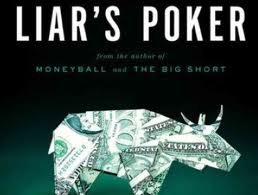
Liar's Poker
"Liar's Poker is a non-fiction, semi-autobiographical book by Michael Lewis describing the author's experiences as a bond salesman on Wall Street during the late 1980s. First published in 1989, it is considered one of the books that defined Wall Street during the 1980s, along with Bryan Burrough and John Helyar's Barbarians at the Gate: The Fall of RJR Nabisco, and the fictional The Bonfire of the Vanities by Tom Wolfe. The book captures an important period in the history of Wall Street. Two important figures in that history feature prominently in the text, the head of Salomon Brothers' mortgage department Lewis Ranieri and the firm's CEO John Gutfreund."

http://en.wikipedia.org/wiki/Liar%27s_Poker


The Big Short
The Big Short: Inside the Doomsday Machine is a 2010 non-fiction book by Michael Lewis about the build-up of the housing and credit bubble during the 2000s. It describes several of the key players in the creation of the credit default swap market that sought to bet against the collateralized debt obligation (CDO) bubble and thus ended up profiting from the financial crisis of 2007–2010. The book also highlights the eccentric nature of the type of person who bets against the market or goes against the grain.

http://en.wikipedia.org/wiki/The_Big_Short

Sunday, July 8, 2012

Ego Management


This morning I was generally asking my kids for an idea for today's blog. My younger daughter Reia came up with a suggestion, "Ego Management". I thought this was apt considering that in my opinion she very much needed Ego Management. It turned out that the reason for her suggestion was that she shared my opinion. In her opinion I very much needed Ego Management. And both of us very very sure that we were right.

And that is the essence of Ego Management. If you think you need it you probably don't. And if you're sure that you don't need it, you probably do.


I looked around for definitions or explanations of EGO. And surprisingly I couldn't find a simple one. And although I think I know what it is, I have no idea how to define or explain it. The closest I found was:

The ego, or that part of our minds that constantly thinks in terms of “I”, “Me”, and “Mine” is one of the buttons that people can press deliberately or accidentally .
The ego wants to look good, be right, not make mistakes, not admit failure, manipulate, and control or appear in control at all times.


I think a quotation sums it very well:
Ego closes your eyes for the truth.
Selflessness opens them.
Ego makes you lose your self-respect.
Selflessness gains it.


There are a few interesting articles on Ego that you may want to go through.

Wikipedia's article summarizes as:
Id, ego and super-ego are the three parts of the psychic apparatus defined in Sigmund Freud's structural model of the psyche; they are the three theoretical constructs in terms of whose activity and interaction mental life is described. According to this model of the psyche, the id is the set of uncoordinated instinctual trends; the ego is the organized, realistic part; and the super-ego plays the critical and moralizing role.
http://en.wikipedia.org/wiki/Id,_ego_and_super-ego

And Osho has an articles on the spiritual angle titled, Ego - The False Center
http://deoxy.org/egofalse.htm


At the end Reia was right. I did need a lesson on Ego Management. But my Ego doesn't allow me to have the last word, I think she does too. :-)

Sunday, July 1, 2012

Satyamev Jayate, Truth Alone Prevails. Really ?

9 weeks ago a program anchored by Aamir Khan, an actor par excellence debuted on Indian Television. The build up to the show was huge. The marketing done by Star TV network and Aamor Khan phenomenal. The channel spared no efforts to ensure the success of this show including a never heard of simultaneous telecast across all the Star TV boutique, including the regional languages as well as the English Star World.


The show was a huge hit. All of India spoke about it and discussed it. What was strange was that everyone universally said they liked the show, loved the concept, but felt that the show would not do well. This sounded strange considering that if everyone loved it, the viewership would go up. Yet everyone felt that the show would not do too well.

9 weeks and 9 shows later, everyone has been proven right. The TRP's of the show have plummeted and whatever viewership is still present has more to do with the star value of Aamir Khan. So what exactly is the issue ? If a perfectionist like Aamir Khan could not figure it out, the probability that I can is small. Nevertheless let me give it a shot.


The sad fact is that all of the issues being highlighted by Aamir and the show are well known. So its not as if there's anything new being showcased. The problem is with solutions. Even there in most cases the solutions are available and part of the law. What is lacking is implementation. And the show does not have any new ideas on that.

It seems like the show is about awareness. But will making people aware of what they are already aware of help ? I personally think that Yes. Now we know. But when we know that everyone else does too, hopefully it'll make us a little more afraid of doing stuff that is illegal, unethical or plain evil.


The one lesson that all of us can learn from Aamir and Satyamev Jayate is how the online media can be used in an effective manner. Check out the website. Its amazing. In addition to the shows in 6 languages, Tamil, Telugu, Malayalam, Marathi, Bengali, English; it also has all popular social media micro-sites, links, pages.

The list of options available online include:
Online Episodes, Forums, Facebook, Twitter, Message Board, Upload Messages, Upload Videos, Leave Voice Messages, Polls, SMS's
- Ask a Question
- Share Your Solution
- Share Your Story
- Send a Message of Hope

You should check out the website for yourself
http://satyamevjayate.in/

Sunday, June 24, 2012

dysenablia.com

Freia had an idea around a year ago. This week she put it into action. Her sister Reia has a few learning difficulties. Dyslexia, Dysgraphia and Dyscalculia.


You can read more about them at:
http://www.armentalearningacademy.com/pdf/dyslexia.pdf
http://www.dyslexiaa2z.com/

This meant that Reia had difficulty in studying normal subjects, understanding them and doing well in the exams. All of us helped by making notes, trying to teach her in a simplified manner, making stuff interesting and so on.

And that sowed the seed of an idea in Freia. What if all of this help was readily available ? It would help hundreds, no thousands, no 1akhs of students. A little known fact is that globally over 10% of students are estimated to have learning difficulties. Unfortunately in India the reported number is under a couple of percentage points. There seems to be some kind of a taboo in having a medical condition. It seems likely that this has more to do with parents unwilling to accept reality and hence are assuming their child is lazy. This results in them pushing their child to work harder. This results in an undesirable condition where the parents and child become frustrated and depressed.


Imagine if these children and parents had help. Resources that could help them learn in a manner that was suited to their way of understanding. And that is what Freia and her idea "DysEnablia" sets out to do. It aims to get parents, teachers, students to come together and contribute content. Even if some of them take the trouble of helping create content, in a very short time a large amount of content would be created.

The content could be a combination of notes, audio, video, animation, applications, ... I guess whatever will enable.


Freia starts her journey of trying to convince teachers, parents and students to contribute this week at her alma mater, Bombay Scottish School, Powai. Here's wishing her all the very best and hoping that her endeavor will help not only her sister Reia, but the large number of children in making studies if not enjoyable, then at least bearable.

Sunday, June 17, 2012

India's Presidential Elections

India will have its Presidential Elections on July 19th. The votes will be counted on July 22nd on which day the 13th President of India will be announced. Everyone is discussing the candidature of the current finance minister Pranab Mukherjee who is being supported by the ruling UPA coalition and P. Sangma, former speaker of the Lok Sabha being supported by most members of the opposition NDA.


Interestingly not many know how exactly the elections are held and how the President is elected. Most of us are aware that voting is done by elected members of the Lok Sabha, Rajya Sabha and State Legislatures. Not many are aware as to what happens after that.

The voting methodology is pretty straight forward. All elected members get 1 ballot to select their choice for President. They have the option of giving a 2nd, 3rd, ... choice based on the number of candidates running for the election. Each ballot represents a certain number of votes. For the 2012 election each ballot cast by elected members of the Lok Sabha and Rajya Sabha represents 708 votes.


The value of each ballot of the State Legislative Assembly and Union Territories is different for each one. The highest value is for Uttar Pradesh at 208 and the least for Sikkim at 7.The values for each state can be seen at the Election Commission of India's website
http://eci.nic.in/eci_main/President_VP_Elec2012/DirectionsNumber_Votes.pdf

The question that comes to mind is how exactly are these numbers arrived at. Like most things in life this too is pretty simple. The first rule used is that the total value of votes of the Rajya Sabha and Lok Sabha members will be the same as i.e. equal to the value of the cobined votes of all the State and Union Territories Legislative Assembly members.

The value of each member of the State Legislative Assemblies is calculated by dividing the population of the State by the total number of elected members. The quotient is then divided by 1,000. The total value of all members of each State is then totalled. This number is then divided by the total number of elected members of the Lok Sabha (543) and Rajya Sabha (233).

The slight disappointment is that the population is taken as per the 1971 census and this has changed, albeit not significantly enough to make a major difference to the relative allotment of votes or to the final results of the Elections.

The Election Commission of India has a very simple and easy to understand FAQ on the Presidential Election.
http://eci.nic.in/eci_main/President_VP_Elec2012/Presidential_Elections-FAQ.pdf

The other interesting aspect of the Presidential Election is that in case there are 3 or more candidates, then there is a first round of counting. In the event that a candidate secures more than 50% of the valid and eligible votes cast, then s/he is declared elected. Else, the candidate with the lowest number of votes is eliminated and a count of votes cast for that candidate is added to the 2nd choice if marked on those ballot papers. At each stage its checked if the leading candidate has secured more than 50% of the votes, elese the process continues till a candidate secures more than 50% of the votes or there is just 1 candidate left.

And thus is the President of the country elected.